

Da Vinci's Ghost: Genius, Obsession, and How Leonardo Created the World in His Own Image
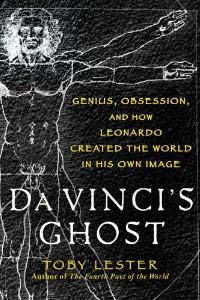
Everybody knows Leonardo’s iconic picture of a man standing in a circle and a square. It’s everywhere, deployed on everything from coffee cups and T-shirts to corporate logos and international spacecraft, celebrating subjects as various as the grandeur of art, the beauty of the human form, and the universality of the human spirit. It’s the world’s most famous cultural icon—yet nobody knows its story. This book brings Vitruvian Man to life by resurrecting the ghost of a largely forgotten Leonardo. It’s a fun and surprising tale that ropes together an eclectic cast of characters: ancient Greek sculptors and philosophers; the Roman architect Vitruvius and the emperor Caesar Augustus; early European monks and Muslim astrologers; Hildegard of Bingen and other mystics; medieval cathedral builders; Renaissance anatomists, architects, art theorists, doctors, engineers, and painters —and in the starring role, of course, Leonardo himself.
Amazon | Amazon UK | Apple | B&N | Books-a-Million | IndieBound
Reviews
Best Books of 2012 (Financial Times, December 3, 2012)
"A wonderfully imaginative intellectual detective story that takes us across centuries of western history. The starting point is Leonardo’s iconic drawing of a nude male figure fitting exactly within a circle and a square. [Lester] sets out to uncover the thinking behind the image, connecting ideas and people from classical and medieval times to the Renaissance and providing us along the way with an endearingly human portrait of the great polymath himself."
Paperback Row (The New York Times, November 21, 2012)
“'Vitruvian Man,' Leonardo’s famous 1490 drawing of a man inscribed in both a circle and a square, is the subject of this rewarding history. Lester traces the conceptual origins of the drawing back to ancient Greece, and to Vitruvius himself, reconstructing Leonardo’s fascination with the idea of man as a microcosm of the universe."
Review (Times Literary Supplement, June 29, 2012)
"A tale entertainingly told . . . the drawing at the heart of this book is one of the compelling images of Western art, and Lester has done a real service by setting it in context with so deft a touch and with so strong a narrative drive."
Review (The New Republic, May 2, 2012)
"Lester’s book is a fascinating account in many ways. His great skill is for contextualizing long-forgotten ideas and carrying them across centuries, showing how and why they circulate, seem to be forgotten, and are suddenly remembered only to be reinterpreted anew ... Though previous biographies do treat Leonardo’s Vitruvian Man, most only sketch the context of the microcosm and point out that Leonardo was deriving his ideas from many sources, including contemporary master-builders and artist-engineers such as Francesco di Giorgio and the earlier Leon Battista Alberti. Da Vinci’s Ghost sets the drawing firmly in its time and intellectual place."
Review (Star Tribune, April 14, 2012)
"It's an absorbing tale that integrates philosophy, geography, cartography, architecture, anatomy and even the mysticism of Hildegard of Bingen. In the wrong hands, this ambitious undertaking could be dry, impenetrable and pedantic. Luckily, it is in the thoroughly capable hands of Toby Lester, a master of connected thinking whose sparkling prose makes medieval anatomical and architectural theory not only comprehensible but downright fascinating."
Review (PopMatters, March 27, 2012)
"Toby Lester takes the reader on a well-researched, meandering journey that begins during the Roman Empire and illuminates a string of connections between art, architecture, the beginnings of modern medicine, and the church, culminating in the Vitruvian Man, as we know him."
Review (The New Yorker, March 26, 2012)
"This short, engaging book provides historical and intellectual contexts for one of the world's most famous drawings, Leonardo's 'Vitruvian Man' . . . Leonardo, Lester argues, 'is every bit as medieval and derivative as he is modern and visionary.'"
Review (Bloomberg, March 20, 2012)
"A compact and entertaining treatise on the history of ideas, written with the light touch of a journalist."
Review (The American Scholar, March 1, 2012)
“This is an enthralling book about a famous drawing and its equally famous creator, who becomes disarmingly, even heartbreakingly human in the author’s sympathetic hands.”
Review and related reading (Library Journal, February 29, 2012)
“A fascinating journey with a lively pace, intriguing illustrations, a large cast of characters, and intertwined stories that jump and skip through history.”
Review (Dallas Morning News, February 24, 2012)
“Drawing on history, art, astronomy, geometry, geography and religion, Lester skillfully unpacks Vitruvian Man to reveal a vast landscape of human thought and achievement.”
Review (Cleveland Plain Dealer, February 23, 2012)
"A very readable history of what can justifiably be called "the world's most famous drawing," Leonardo's "Vitruvian Man." Lester [has] a special talent for focusing on what seems a very narrow subject -- here, a single image -- as a lens into a broader understanding of an age, and how people viewed the world around them.”
Review (USA Today, Feburary 19, 2012)
“Da Vinci's Ghost is a . . . complex mosaic, combining centuries and layers of relevant religion, architecture, art, early science and personalities, plus a rich variety of historic illustrations, to trace the influences that may have led Da Vinci to that moment when he penned the famous drawing.”
Editor’s Choice (The New York Times Book Review, February 12, 2012)
Review (The Christian Science Monitor, February 8, 2012)
“A taut, engrossing tale that spans nearly 2,000 years and has its origins in the ancient Rome of Caesar Augustus.”
Review (The San Francisco Chronicle, February 5, 2012)
“Chief among the many pleasures of Toby Lester's new book, Da Vinci's Ghost: Genius, Obsession, and How Leonardo Created the World in His Own Image, is the Leonardo da Vinci who emerges from its pages. You won't find Robert Langdon's rarefied, enigmatic wizard of the Italian Renaissance here. The Leonardo Lester draws is charmingly human.”
Review (The New York Times Book Review, February 5, 2012)
“[A] richly rewarding history… [Vitruvian Man] captures, as Lester eloquently observes ‘the intoxicating, ephemeral moment when art, science and philosophy all seemed to be merging, and when it seemed possible that, with their help, the individual human mind might actually be able to comprehend and depict the nature of . . . everything.’”
Review (Library Journal, February 1, 2012)
“Verdict: A book for anyone who was wondered about the genius of Leonardo da Vinci and the Italian Renaissance, it will enlighten students and specialists as well as the reading and museum-going public.”
Best of the Month (Amazon.com, February, 2012)
Hot Type selection (Vanity Fair, February, 2012)
“Toby Lester paints the genius of Leonardo in Da Vinci’s Ghost.”
Review (Salon, January 29, 2012)
“Lester eloquently proposes the Vitruvian Man ‘as a study of human proportion; as an overview of the human anatomy; as an exploration of an architectural idea; as an illustration of an ancient text, updated for modern times; as a vision of empire; as a cosmography of the lesser world; as a celebration of the power of art; as a metaphysical proposition.’ Da Vinci’s Ghost teases out the threads of these ideas from the centuries of Western culture that preceded the moment when Leonardo set pen to paper.”
10 winter titles sure to entice you (USA Today, January 12, 2012)
20 non-fiction books to watch for in 2012 (Christian Science Monitor, January 5, 2012)
Review (The Independent, December 21, 2011)
"[Da Vinci’s Ghost] is more than the description of a great drawing, the so-called "Vitruvian Man", executed in 1490. It demonstrates, with skill and lightly worn erudition, how Leonardo, aged 38, came to make his drawing ... a very well written and lucidly argued piece of intellectual synthesis.”
Review (The Scotsman, December 17, 2011)
“A fascinating intellectual history ... expertly told. Lester has got form here.”
Review (The Financial Times, December 16, 2011)
“Given how many texts have been devoted to Leonardo da Vinci, any new study must be special. Toby Lester’s Da Vinci’s Ghost hits the mark. It offers a compelling portrait of Leonardo ... and leavens scholarship with storytelling and graceful prose.”
Lead review (The Sunday Times, December 11, 2011)
Review (The Book Bag, December 7, 2011)